Side-by-side comparisons of leading data analytics platforms, breaking down key differences, strengths, and ideal use cases to support informed decision-making.
Allston Yale Serves Businesses in Texas and across the USA
When Houston business leaders start shopping for a business intelligence tool, Google Looker Studio is almost always on the shortlist because it has a genuinely useful free tier. Power BI, by contrast, is paid from day one for anything beyond personal use. The real comparison is not feature for feature. It is whether a free BI tool can carry your business as far as you need to go, and where the line sits when it stops being free enough.
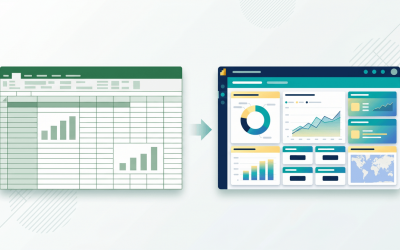
Excel and Power BI are both Microsoft tools, but they were built for completely different jobs. For Houston businesses still running their monthly close, sales reporting, and executive dashboards out of a stack of linked spreadsheets, the question is not whether Power BI is better. It is whether you have crossed the line where Excel has quietly become the most expensive part of your reporting stack.
Choosing the right foundation for your data determines how quickly your organization can move. An on-premises environment offers deep control over the hardware and software layers. In contrast, the cloud solution provides a software as a service experience that integrates all tools into one unified workspace.
Choosing between Microsoft Fabric and Oracle Database depends on whether the priority is unified SaaS analytics or robust transactional integrity. While Fabric offers an all-in-one platform for modern insights, Oracle remains the gold standard for high-performance enterprise workloads across various industries. Organizations must weigh the benefits of a consolidated software-as-a-service environment against the deep, proven capabilities of a traditional relational database management system. When evaluating these options, we often see that a direct comparison of features reveals a fundamental shift in how businesses handle data lifecycle management in 2026.
Deciding between Microsoft Fabric and Azure SQL requires a clear understanding of their distinct roles in a modern tech stack. While one is an integrated SaaS solution for end-to-end analytics, the other is a powerful PaaS database designed for transactional workloads and application backends.
Choosing between these two powerhouses is not just a technical debate; it is a fundamental choice about your company's digital future. Most organizations find that the right path depends on their existing ecosystem and the complexity of their business logic. You need a platform that turns data from a cost center into a major asset.
Choosing between Microsoft Fabric and Google BigQuery is a strategic crossroads for any data-driven organization today. Both platforms offer robust features for managing large-scale data, yet they diverge significantly in their architecture and user experience. Understanding these nuances is essential for selecting the right analytical foundation.
The selection between Microsoft Fabric and Amazon Redshift ultimately hinges on whether your organization prioritizes a unified, SaaS-based ecosystem or a highly customizable, performance-tuned data warehouse. While Fabric excels in ease of use and deep Microsoft 365 integration, Redshift remains a powerhouse for massive SQL workloads.
Deciding between Microsoft Fabric and Snowflake feels like choosing between a Swiss Army knife and a surgical scalpel. Fabric offers a unified SaaS environment that keeps everything in the Microsoft family. Snowflake provides a high-performance, multi-cloud engine that prioritizes speed and flexibility for data warehousing and sharing needs.
Allston Yale’s Knowledge Hub is your trusted resource for navigating the evolving world of data platforms. Whether you're deciding between Power BI and Tableau or learning how Microsoft Fabric compares to Azure, our expert guides simplify complex tools, enabling smarter data strategies across your enterprise.