May 22, 2026
Friday Fabric Facts #3: Stop Paying the 'ETL Tax': The Case for Zero-Copy Analytics in 2026
For the last decade, the data industry sold us a very expensive lie: "To analyze your data, you must first centralize it."
We accepted "Data Gravity" as a law of physics.
We built massive ETL pipelines.
We paid millions in egress fees.
We waited 24 hours for "daily loads" to complete.
And we accepted that 40% of our engineering budget would be spent just moving bytes from Point A (AWS S3) to Point B (Our Warehouse) before a single decision could be made.
That era is over. The new law of physics is Data Virtualization.
Microsoft Fabric’s OneLake Shortcuts architecture represents a fundamental shift in how we think about data sovereignty.
It validates a thesis I have held for years: The value of data is defined by its accessibility, not its location.
Today, I’m unpacking why the "Centralize Everything" strategy is failing modern SMBs, and why the future belongs to architectures that leave data where it lands.
The Professional Reality: The "Shadow Data" Crisis
In my work advising CIOs at $50M–$100M organizations, I see the same pattern repeatedly.
Let’s call it the "Logistics Paradox."
I recently audited the architecture of a mid-market logistics firm ($90M ARR).
Their core operational ERP lived in Azure SQL.
But their most valuable competitive asset, 5 years of telemetry data from their fleet sensors, sat dormant in AWS S3 buckets.
Why?
Because their data strategy was built on the "Centralize Everything" dogma.
To bring that S3 data into their Azure analytics environment required:
- Massive Engineering Lift: Building robust pipelines to move 40TB of history.
- Prohibitive Cost: AWS egress fees + Azure storage duplication fees.
- Latency: A 24-hour delay that rendered "real-time route optimization" impossible.
The result? The data stayed in S3.
The "Shadow Data" remained dark.
The insights, which could have saved them 15% in fuel costs, were lost.
This isn't a tooling problem.
It is a strategy problem.
They were trying to solve a 2026 problem with a 2015 playbook.
The Strategic Shift: Virtualization Over Replication
Microsoft Fabric’s OneLake Shortcuts validates a different approach.
It acknowledges that multi-cloud is not a temporary inconvenience, it is the permanent state of modern enterprise.
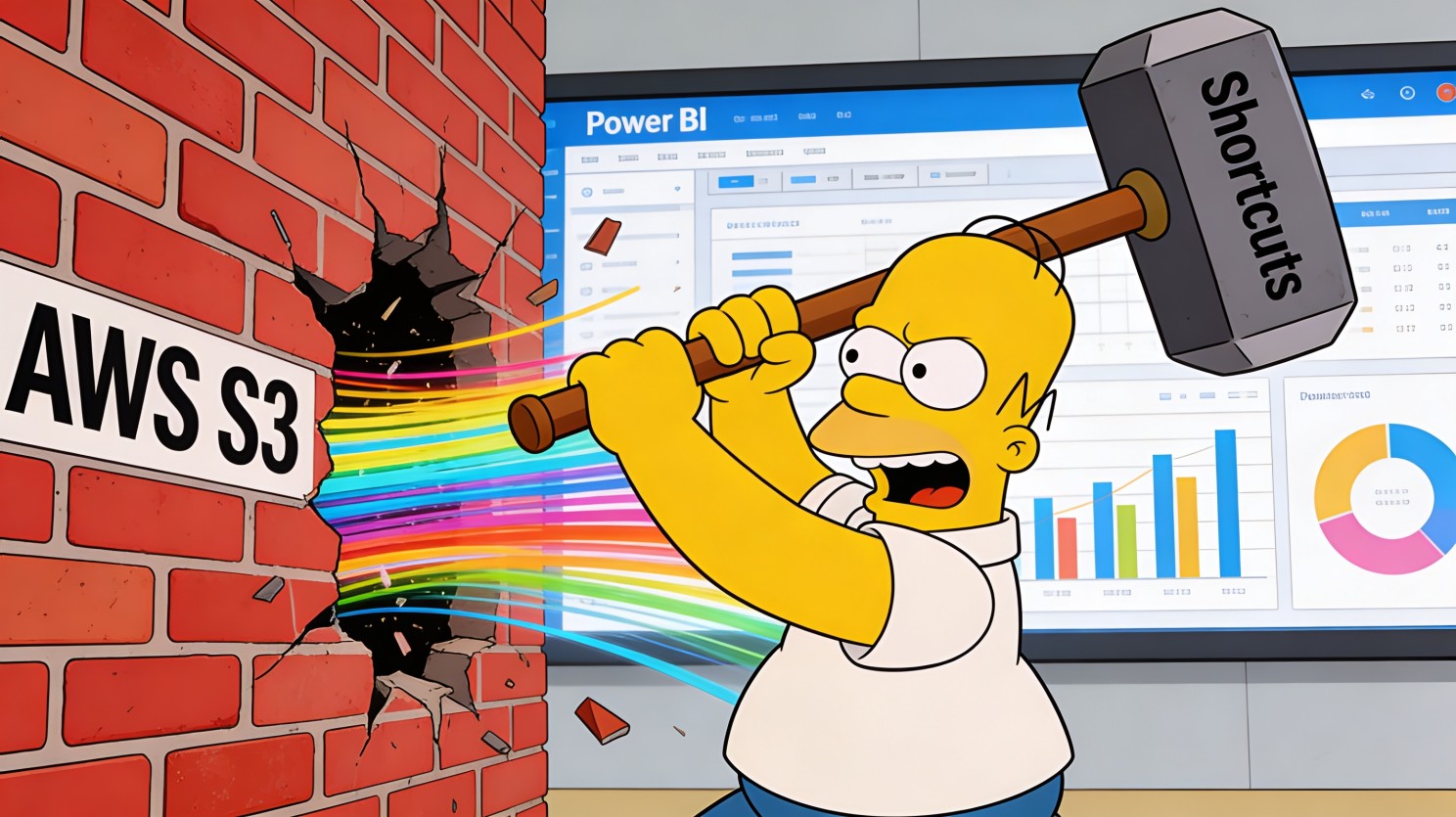
By allowing us to "mount" external storage (AWS S3, Google Cloud, ADLS Gen2) directly into the compute environment without moving the physical files, we change the economic equation of analytics.
This is not just a feature update. It is an architectural philosophy:
- Decouple Compute from Storage: Run your high-performance Power BI compute engines in Azure while your raw assets remain in cheap AWS S3 cold storage.
- Eliminate the "ETL Tax": Stop paying engineers to build plumbing. Start paying them to build models.
- Federated Governance: Apply a single security model (Fabric) over distributed assets.
In the case of that logistics firm, the solution wasn't a better pipeline. It was virtualization.
We used Shortcuts to mount the S3 buckets.
The data never moved.
The cost of duplication was zero.
But suddenly, Power BI could see 5 years of history as if it were local.
The outcome wasn't just "faster reports."
It was business agility.
They launched their route optimization model in 3 weeks, not 6 months.
Strategy is useless without execution.
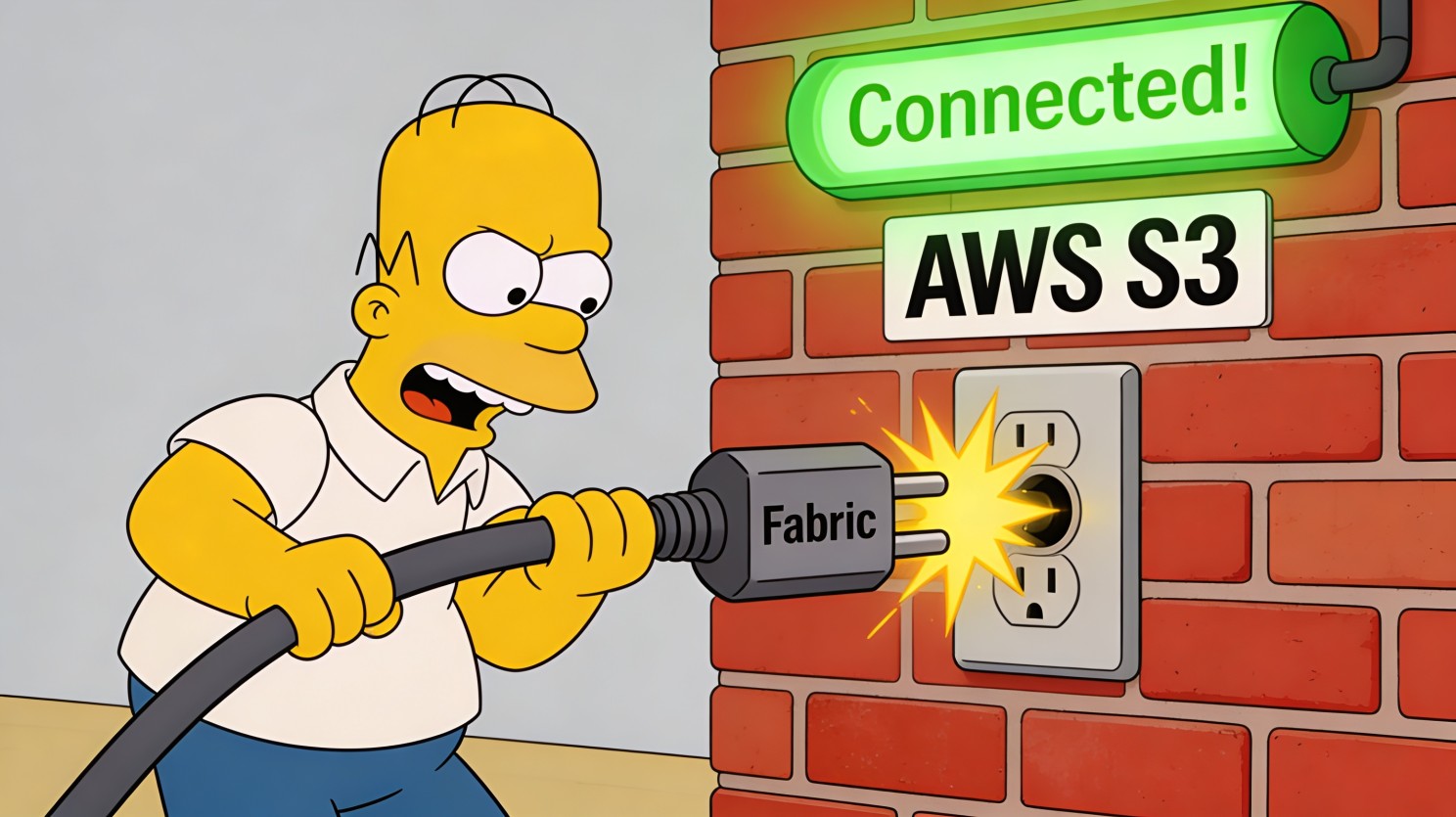
Here is how we connect S3 data to Fabric in 5 minutes, proving that cross-cloud analytics is now a configuration task, not an engineering project.
1. Get your AWS Credentials ready
- Log into AWS IAM.
- Create a user with s3:GetObject and s3:ListBucket permissions.
- Copy the Access Key ID and Secret Access Key.
2. Create the Shortcut in Fabric
- Open your Fabric Lakehouse.
- Right-click on "Files" or "Tables" → Select "New shortcut".
- Select "Amazon S3" from the list.
- Enter your bucket path (s3://my-bucket-name) and paste your credentials.
3. Query it immediately
- The S3 folder now appears in your Lakehouse explorer as if it were a local folder.
- Right-click a CSV or Parquet file in that folder → "Load to Table".
- Open a SQL Endpoint and write: SELECT TOP 100 * FROM MyS3ShortcutTable.
- Boom. Cross-cloud analytics.
The "Gotcha" That No One Discusses
However, strategy requires nuance.
The danger of virtualization is that it makes cross-cloud querying feel too easy.
I often see teams confuse accessibility with performance.
Just because you can query a JSON file in S3 directly doesn't mean you should use it for a CEO's dashboard.
My Thinking Framework: When designing these architectures, I classify data into two strategic tiers:
- "Cold" / Exploratory Data: Leave it where it is (S3). Use Virtualization (Shortcuts). This is for data scientists and ad-hoc analysis where latency is acceptable but agility is paramount.
- "Hot" / Decision Data: If this data powers a daily KPI dashboard for the C-Suite, virtualization is the ingestion method, not the serving layer. We use the Shortcut to load the data into a cache or Delta table for sub-second performance.
True expertise is knowing when to break the rule.
Virtualization is the bridge, not always the destination.
A Note to My Partners & Peers
The shift to Fabric and Data Virtualization opens a new era for us as technology leaders.
We are no longer "pipeline builders."
We are Decision Architects.
The value we bring to our clients, whether you are an internal leader or a consulting partner, is no longer in how efficiently we can move data. It is in how effectively we can curate it.
If you are a Microsoft Partner, an MSP, or a Digital Agency struggling to articulate this shift to your clients, or if you need a specialized architect to design the data foundation for your digital transformation projects, this is where I operate.
My team and I focus on the strategic layer of Data & AI readiness. I don't just build reports; I design the decision engines that power modern SMBs.
Let’s elevate the conversation.

Isaac Truong | Founder, Allston Yale
Enterprise-grade analytics for $50M–$100M SMBs
Power BI | Fabric | Azure | Data Strategy
📅 Book a 20-min Fabric diagnostic →
📧 Subscribe to get Friday Fabric Facts in your inbox (plus early access to templates) 💼
LinkedIn: Connect with me for daily Fabric tips
Friday Fabric Facts #3: Originally Posted on LinkedIn, February 13, 2026